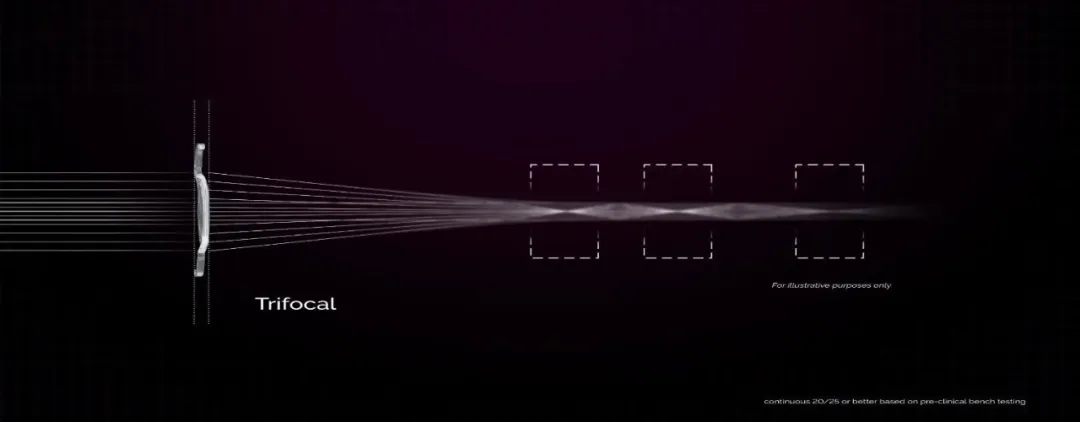
Recently, Prof. Guo Haike, President of Shanghai HePing Eye Hospital, led his team to successfully complete the first clinical implants in China of the Johnson & Johnson TECNIS Odyssey full-vision-range intraocular lens (IOL) — a next-generation premium lens for patients seeking seamless, glasses-free vision after cataract surgery.
The TECNIS Odyssey is the world's first full-vision-range (FVR) IOL to receive dual regulatory approval from both the U.S. FDA and China's NMPA. Its successful launch at HePing Eye underscores the hospital's system-level capabilities in refractive cataract surgery, precision diagnostics, and complex-case management.
Precision First: A Rigorous Preoperative Assessment System
Facing growing demand for high-quality visual outcomes, Shanghai HePing Eye Hospital has established a standardized, digital preoperative evaluation workflow. Every patient undergoes a comprehensive battery of tests including anterior-segment imaging, IOL-Master biometry, ITrace visual-function analysis, OCT retinal imaging, and B-scan ultrasonography.
The hospital's dedicated Refractive IOL Measurement & Calculation Center selects individualized formulas and lens powers based on each patient's ocular biology. Prof. Guo's team has extensive experience managing complex refractive cases, guided by the principle that the right lens must be matched to the right patient.
The patient who received the first Odyssey implant had high expectations for postoperative visual quality, with preoperative cataract, astigmatism, and presbyopia. After rigorous evaluation and a personalized surgical plan, Prof. Guo's team performed a single minimally invasive procedure that simultaneously addressed all three conditions — with a satisfactory outcome.
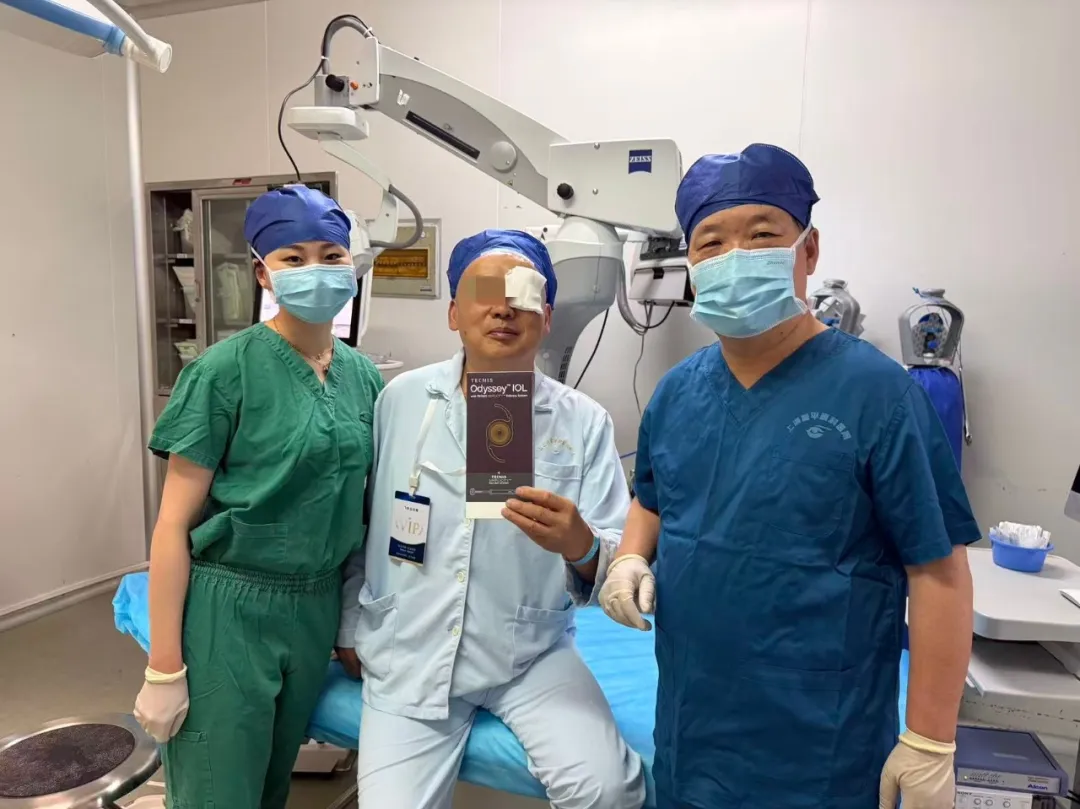
The patient and team mark the successful first implant with the Odyssey IOL certificate.
Technology at Work: Five Core Advantages of Odyssey
1. Seamless Full Vision Range — No Visual Gaps
Unlike traditional trifocal lenses that rely on segmented focal points, the Odyssey IOL features 15 evenly spaced, full-aperture diffractive rings. It makes use of otherwise-unused secondary diffractive light to create continuous, uniform vision from 33 cm (near reading) to infinity (distant vision), with no perceptible jumps between zones.
Clinical data show that patients can read text 14% smaller than with comparable lenses, and 93% achieve full glasses independence after surgery.
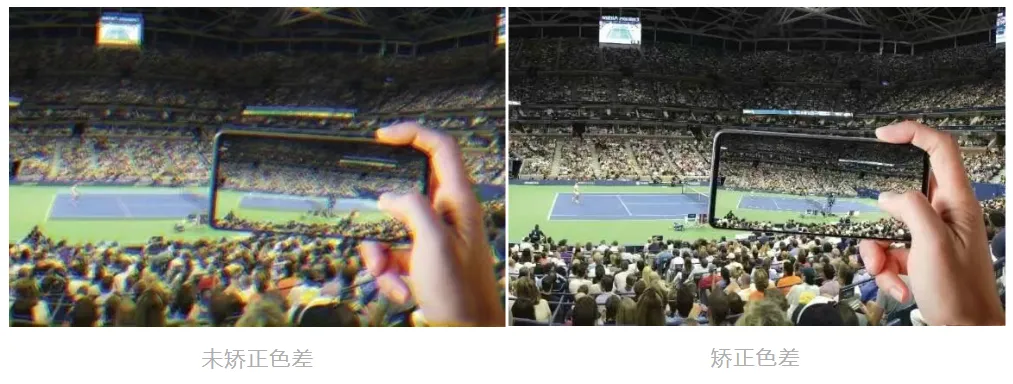
Odyssey's continuous full visual range covers near, intermediate, and far distances in one lens.
2. Patented Achromatic Technology — Better Night Vision
The lens substrate uses proprietary TECNIS material with a high Abbe number of 55, combined with achromatic technology that reduces chromatic blur. Under 5 mm large-pupil low-light conditions, distant contrast sensitivity is 2.4 times better than with mainstream trifocal lenses. When the pupil dilates from 3 mm to 5 mm, visual clarity degrades by only 16%, giving patients significantly better night-driving performance.
Odyssey's achromatic correction reduces color fringing for sharper low-light vision.
3. Half-Step Diffractive Structure — Reduced Halos and Glare
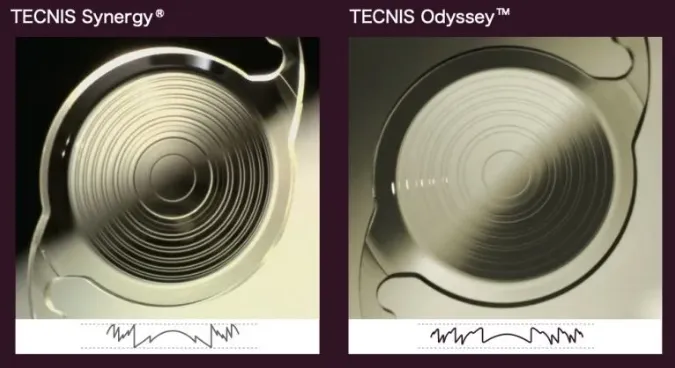
Odyssey reduces diffractive step height by 50% and pairs it with a smooth, curved blend zone. This design weakens the optical sources of nighttime halos and glare at the source. Follow-up data show 93% of patients experience no halo or only mild halo and glare after surgery.
4. High Tolerance for Residual Error and Decentration
The optimized optical structure is more forgiving of residual refractive error. Even if mild myopia, hyperopia, or astigmatism remains after surgery, more than 95% of eyes still achieve excellent distance vision. The lens also demonstrates improved resistance to slight intraoperative decentration, making outcomes more predictable. For patients with astigmatism, the Odyssey Toric II variant averages only 0.94° of postoperative rotation, minimizing the need for repositioning.
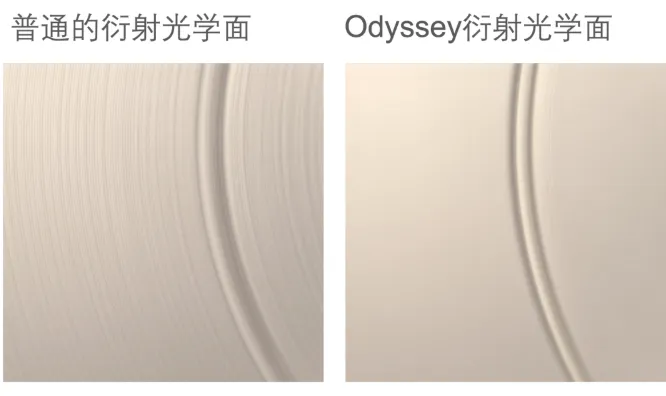
TECNIS Synergy and Odyssey IOL platforms compared: Odyssey's smoother diffractive architecture reduces optical disturbances.
5. Simplicity Preloaded System — Streamlined Surgery
The Odyssey IOL is delivered through the Johnson & Johnson SIMPLICITY preloaded injector system. The implant is completed in three steps — hydration, advancement, and insertion — through a 2.2–2.4 mm micro-incision. The controlled, stable delivery lowers intraoperative contamination risk and supports faster postoperative recovery.
Beyond the Lens: Rebuilding Quality of Life
At Shanghai HePing Eye Hospital, the goal is not simply to exchange a cloudy lens. Prof. Guo Haike's approach to refractive cataract surgery places the patient at the center, shifting the focus from treating disease to treating the person, and from studying products to understanding visual systems and human needs.
The evaluation process goes beyond visual-acuity numbers. The team also assesses contrast sensitivity, binocular fusion, and stereoscopic vision — higher-level visual functions that determine real-world satisfaction.
"Refractive cataract and presbyopia management must integrate the concepts of binocular balance, systemic health, psychophysics, medical psychology, sociology, and epidemiology. We bring together geometric optics, neurophysiology, and visual science to design surgical plans and set realistic visual goals." — Prof. Guo Haike

Prof. Guo Haike and the HePing Eye team celebrate the national first-implant milestone.
A Tradition of Leading the Field
From the first domestic implantations of various premium IOLs to the latest TECNIS Odyssey launch, Shanghai HePing Eye Hospital has consistently demonstrated the clinical acumen and technology adoption speed to keep pace with international ophthalmology. This commitment to precision and patient-centered care has built a strong reputation in refractive cataract surgery and continues to attract patients from across China and around the world.
Looking ahead, the hospital will continue to leverage its expertise in refractive cataract surgery, bringing more patients a clearer, more durable, and more comfortable "full-vision-range" life.
International patients considering cataract or presbyopia treatment can begin with a remote consultation. Request a consultation →